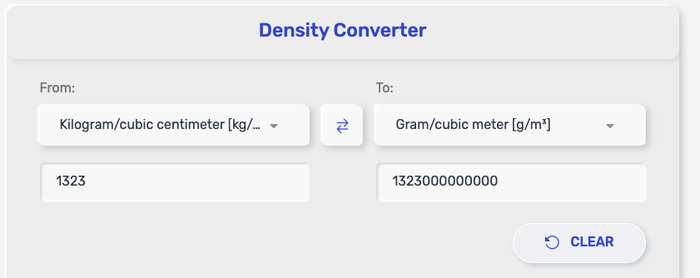
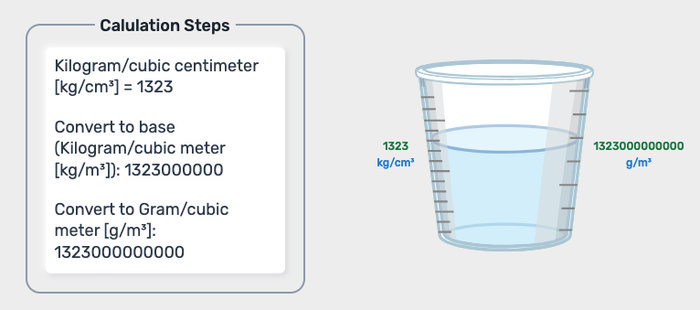
Use this density unit converter to convert between common density units like kg/m³, g/cm³, lb/ft³, and lb/in³. Pick your input unit, enter a value, choose the output unit, and get the converted result instantly—great for homework, lab notes, and field calculations.
How to Use This Density Converter Calculator
Converting density units here is straightforward: type your number, pick the units, and the tool will return the matching value in the new unit.
Enter the density value you want to convert (for example, 1.25 or 997).
Select the “from” unit (the unit your value is currently in), such as kg/m³, g/cm³, or lb/ft³.
Select the “to” unit (the unit you want to convert to), like g/mL, g/L, or lb/in³.
Click Convert to generate the converted density instantly.
Copy the result or adjust rounding/decimal places if you’re formatting it for homework, a lab report, or a spec sheet.
Density Units You Can Convert With This Tool
This density converter covers the units you’ll see most often in school problems, lab work, and material specifications. Just choose your input unit and output unit—no extra setup needed.
Metric density units
These are common in SI-based worksheets, engineering notes, and most scientific references:
kg/m³ (kilograms per cubic meter)
g/cm³ (grams per cubic centimeter)
g/mL (grams per milliliter)
kg/L (kilograms per liter)
g/L (grams per liter)
mg/mL (milligrams per milliliter)
mg/L (milligrams per liter)
Imperial / US customary density units
These show up often in US material tables, construction contexts, and older references:
lb/ft³ (pounds per cubic foot)
lb/in³ (pounds per cubic inch)
oz/in³ (ounces per cubic inch)
Lab-style “per liter” units (quick mixing and solutions)
If you’re working with concentrations that are written like density (mass per volume), these formats are especially common:
g/L
mg/L
g/mL
mg/mL
If you don’t see the exact unit you need, a good workaround is to convert first into a widely supported base like kg/m³ or g/mL, then convert again to your target unit.
What Your Converted Density Means
Your converted value represents the same physical density, just written in a different unit. Nothing about the material changes—only the unit scale changes.
It’s normal if the number looks much larger or smaller after conversion. For example, density shown in kg/m³ will look very different from g/mL or lb/in³ because those units measure volume in very different sizes.
Use the converted density anywhere you need a specific unit format, such as:
Filling in homework or exam answers
Standardizing units in a lab report
Comparing material density specs from different sources
Checking shipping/packaging requirements that request a specific density unit
Estimating mass from volume (or volume from mass) when you already know one of them
Quick Reference Conversions (Common Density Unit Equivalents)
Sometimes you don’t even need a full conversion workflow—you just want a fast checkpoint. These quick equivalents cover the density unit pairs people convert most often in school, lab work, and material specs.
Metric anchors
1 g/cm³ = 1000 kg/m³
1 g/mL = 1000 kg/m³
1 g/mL = 1 g/cm³
1 kg/L = 1000 kg/m³
1 g/L = 1 kg/m³
1 mg/mL = 1 kg/m³
1 mg/L = 0.001 kg/m³
Imperial / US customary anchors
1 lb/ft³ ≈ 16.0185 kg/m³
1 kg/m³ ≈ 0.062428 lb/ft³
1 lb/in³ ≈ 27679.9 kg/m³
1 kg/m³ ≈ 0.000036127 lb/in³
1 oz/in³ ≈ 1729.99 kg/m³
1 kg/m³ ≈ 0.000578704 oz/in³
Quick “sanity check” tips
If your converted result looks odd, these quick checks usually catch mistakes:
Switching between g/mL and g/cm³ shouldn’t change the number.
Converting g/cm³ → kg/m³ should multiply by 1000.
Converting lb/in³ often creates very large values in kg/m³ (because in³ is tiny).
If you want, I can format this section as a compact table for the tool page layout (still no links).
Rounding, Significant Figures, and Display Settings
Rounding is mostly about context. If you’re doing a multi-step calculation, keep more digits while working, then round once at the end. If you’re reporting a final value (homework answer, lab report, spec sheet), round to a precision that matches the quality of the original measurement.
When to round
During internal calculations: avoid early rounding. Extra digits reduce drift when you convert units and then use the value again (for example, density → mass from volume).
For final reporting: round the final converted density so it looks clean and matches the format your teacher, lab, or document expects.
3–4 decimals: most homework, general engineering notes, everyday conversions
5–6 decimals: lab-style work, small values, or when your input has high precision
If your input density was measured or given with limited precision, your converted result shouldn’t pretend to be more precise than the original. A simple rule: your final answer should usually have a similar number of significant figures as the input.
Density vs Specific Gravity (What’s the Difference?)
Density and specific gravity are related, but they’re not the same thing—and product sheets often use them in slightly different ways.
Density (has units)
Density is mass per volume, so it always comes with units like:
kg/m³
g/cm³
g/mL
lb/ft³
Manufacturers use density when they want a value you can plug directly into calculations (mass from volume, buoyancy, material selection, shipping specs, lab work).
Specific gravity (no units)
Specific gravity (SG) is a ratio, so it has no units. It compares a material’s density to the density of a reference substance—most commonly water (for liquids and solids) at a stated temperature.
If SG = 1, the material is about as dense as water.
If SG > 1, it’s denser than water.
If SG < 1, it’s less dense than water.
A quick practical shortcut people use:
For many liquids, SG is numerically similar to density in g/mL (because water is about 1 g/mL), but they’re still different concepts—SG is a ratio, density is a measurement with units.
Where you’ll see each on product sheets
Density shows up on: engineering datasheets, material specs, lab documentation, safety/technical documents, shipping calculations, and anywhere a unit-based value is required.
Specific gravity shows up on: chemical product sheets, liquids (oils, solvents, cleaners), safety documents, and industries where quick comparison to water matters (float/sink behavior, mixing, quality checks).
Typical Density Ranges
These ranges are handy for a fast reality check after converting units. Values vary by composition, temperature, and purity, so treat them as practical reference points—not exact constants.
Material / Category
Typical Density Range (g/cm³)
Typical Density Range (kg/m³)
Air (at room conditions)
~0.0011–0.0013
~1.1–1.3
Water (near room temperature)
~0.997–1.000
~997–1000
Seawater
~1.020–1.030
~1020–1030
Gasoline
~0.70–0.78
~700–780
Diesel fuel
~0.82–0.86
~820–860
Vegetable oils (many types)
~0.90–0.93
~900–930
Ethanol
~0.78–0.79
~780–790
Concrete (typical)
~2.2–2.5
~2200–2500
Glass (soda-lime, typical)
~2.4–2.6
~2400–2600
Wood (varies a lot by species)
~0.35–0.90
~350–900
Aluminum
~2.70
~2700
Iron / Steel (typical)
~7.7–8.1
~7700–8100
Copper
~8.9–9.0
~8900–9000
Lead
~11.3–11.4
~11300–11400
If your converted result lands way outside the expected range for the material (for example, “water” showing up far from ~1000 kg/m³), it’s usually a unit mismatch like mL vs L or cm³ vs m³.
References
BIPM (2019, updated) – The International System of Units (SI Brochure), 9th edition https://www.bipm.org/en/publications/si-brochure
NIST (2008) – SP 811: Guide for the Use of the International System of Units (SI) https://www.nist.gov/pml/special-publication-811
NIST (2008) – SP 1038: The International System of Units (SI) https://www.nist.gov/pml/special-publication-1038
IUPAC (Gold Book) – “density” (definition and usage in chemistry/physics) https://goldbook.iupac.org/terms/view/D01590
NPL (National Physical Laboratory) – SI Units and guidance on unit usage (UK metrology reference) https://www.npl.co.uk/si-units
Engineering ToolBox – Density units conversion reference (unit relationships & examples) https://www.engineeringtoolbox.com/density-units-d_132.html
FAQ
Is this density converter calculator accurate?
It uses fixed unit relationships, so the conversion is consistent. Any difference usually comes from rounding settings you choose.
Which density unit should I use for school or lab work?
Many classes use kg/m³ for SI problems, while labs often use g/mL or g/cm³. Use whatever your worksheet or report requires.
Why does the converted number change so much?
Some units are much larger or smaller than others (for example, cm³ vs m³). The material density stays the same—only the unit scale changes.
Can I convert g/mL to kg/m³ here?
Yes—this is one of the most common density conversions.
Do I need to round the final answer?
If you’re submitting homework or a lab report, rounding to match your measurement precision is usually a good idea.
What’s the difference between g/cm³ and g/mL?
They’re numerically equal because 1 cm³ = 1 mL, so the value stays the same while the unit label changes
Can this tool convert imperial density like lb/ft³?
Yes—choose an imperial unit as input or output, then convert like normal.
About us
densityconverter.com is a simple online tool designed to help users quickly convert density units with accuracy and ease. Whether you need to convert between kilograms per cubic meter, grams per cubic centimeter, pounds per cubic foot, or other common density units, this tool provides instant and reliable results for students, engineers, researchers, and everyday users.
Our goal is to make unit conversions straightforward and accessible without requiring complicated software or calculations. With a clean interface and fast performance, Densityconverter.com allows users to convert density measurements efficiently for educational, scientific, and practical purposes.
This tool was created and maintained by a small team of contributors passionate about building useful and easy-to-use online utilities that simplify everyday calculations.
We continue to improve densityconverter.com to ensure accurate results, a smooth user experience, and a dependable resource for density unit conversions online.
Policy
We are committed to providing accurate, accessible, and transparent tools for users around the world.
Data and Privacy
densityconverter.com does not require registration and does not collect or store personal information. Any values entered into the converter are used only to perform the unit conversion and are not saved or shared.
Accuracy Disclaimer
This converter uses standard unit conversion formulas commonly accepted in science and engineering. While we strive to ensure accuracy, the results are intended for informational and general use only. Users should verify results when using them for professional, scientific, or safety-critical applications.
Responsible Use
By using this tool, you agree to use it responsibly. The developers and contributors are not liable for any decisions, calculations, or outcomes based solely on the results generated by this converter.
Policy Updates
We may update this policy periodically to reflect improvements to the tool or changes in our practices. Any updates will be published on this page to maintain transparency.